Designing a Modern Personal Finance Ecosystem
Building a cohesive financial ecosystem that turns user data into forward-looking insights - enabling smarter decisions and unlocking future AI-driven planning capabilities.
Project Overview
This project focuses on designing a smart personal finance platform tailored for users in the UAE. Residents often make high-impact financial decisions such as upgrading homes, buying cars, or increasing remittances without structured guidance or foresight. Existing tools either look backward, like bank-based expense trackers, or lack local relevance, like generic global apps, leaving a critical gap in decision support. The application addresses this by positioning itself not as a budgeting tool, but as a financial decision intelligence platform, one that analyzes user behavior, forecasts cash flow, and enables “what-if” simulations to help users understand the financial impact of decisions before they commit.
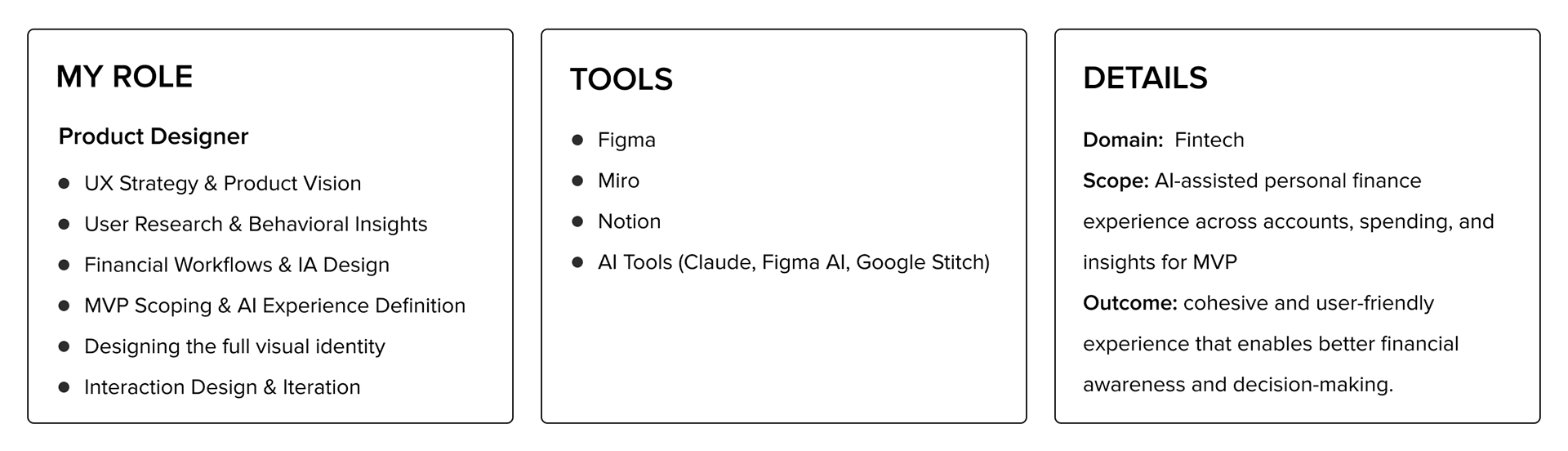
In previous projects in this portfolio, my role was Lead UX Designer solving experience problems within a defined product scope. This project is different. I originated the product concept with the founders, defined its category, set the product strategy, and designed the full end-to-end experience as Product Designer.
Business Opportunity & Product Vision
The UAE personal finance market is large, digitally engaged, and under-served at the decision layer. Over 85% of UAE residents are expatriates managing money across borders, salary cycles, and major life transitions like rent renewals, car purchases, family remittances. Every existing product is reactive: it records what already happened. None of them help a user answer "can I actually afford this move?" before they make it.
The product vision for Savero is to own the pre-decision moment. The 24 hours before a major financial commitment when a person needs clarity, not more data. The tagline we chose, clarity before decisions, is not a marketing line. It is a design constraint that every screen, copy decision, and feature scope choice was measured against.
Competitive Positioning
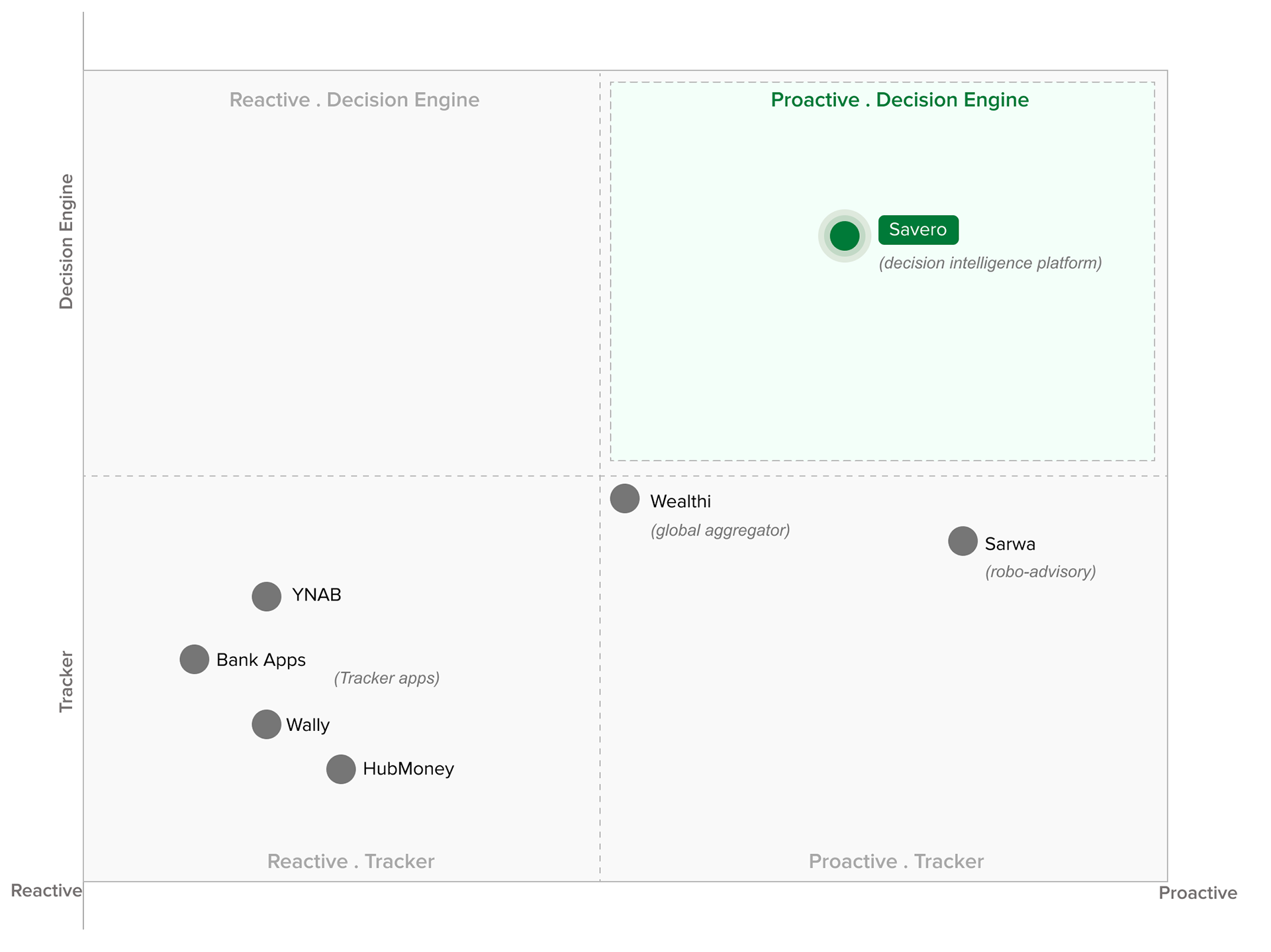
The UAE market offers trackers, budgeting tools, and investment platforms but, no true decision engine. Apps like Wally and HubMoney focus on expense tracking with limited intelligence, while bank apps provide siloed, single-account views. Wealthi, the closest competitor, emphasizes breadth with global aggregation and wide bank connectivity.
Savero takes the opposite approach - depth in the UAE context. It is built around local financial behavior, with Arabic language (RTL) support. This creates a clear white space: no product in the UAE combines cross-bank intelligence, behavioral AI guidance, and a true scenario engine that allows users to simulate financial decisions before committing.
Product Strategy - The Three Layers
Savero is structured as three compounding layers of intelligence. The MLP design position is that all three layers must ship together — a Layer 1-only product is a budgeting app, a Layer 3-only product is a calculator, and neither communicates the product's identity.

Key Decisions that defined the product:
Decision 1: Ship all three layers in the MLP. Releasing only tracking would misclassify Savero as a basic expense app; including even a lightweight scenario engine ensures the product’s decision-intelligence identity is clear from first use.
Decision 2: Single primary colour. A single primary (Wealthy Green) was chosen to eliminate visual competition and create a calm, trustworthy interface, with supporting tones used only to enhance—not compete with—the core signal.
Decision 3: Transparency as the core trust mechanism. Every key metric is explainable in one tap, making transparency a core feature—not an add-on—so users understand the “why” behind numbers and trust the system’s intelligence.
Emotional JTBD: From anxiety to confidence
Every screen was designed to move the user one emotional state forward — from anxiety about scattered finances to confidence in a major decision.
Core Experience Flows
The core flows and onboarding were developed using Figma Make and Claude as iteration accelerators—not for final designs, but to rapidly explore layouts, test structure, and uncover edge cases early. This enabled quick comparison of multiple approaches, revealing gaps like empty states, privacy modes, and calculation transparency before moving to high fidelity. The final experience reflects this loop: AI-assisted exploration grounded in real UAE user contexts, refined into deliberate, well-informed design decisions with fewer blind spots.